
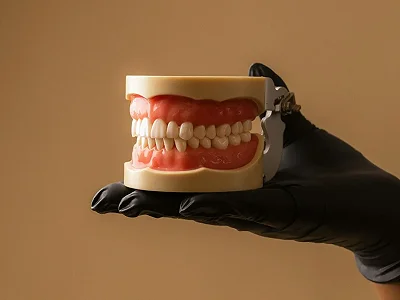
Dental check-up and consultation
zł 150.00
Tooth loss is not only an aesthetic problem but also a serious burden on the entire stomatognathic system. Today, rebuilding your smile and restoring full chewing function are possible quickly and safely thanks to modern prosthodontics. This is a comprehensive approach that takes into account bite anatomy, individual dental characteristics, and the patient's aesthetic expectations. Thanks to modern dentures, you can once again smile freely, speak, and enjoy your favorite foods without discomfort.
Before visiting a dentist, it is worth understanding what prosthodontics is. It is a branch of dentistry dealing with the restoration of lost or significantly damaged teeth using special prosthetic constructions.
Modern technologies enable the creation of restorations that are as close as possible to natural teeth in terms of shape, color, and enamel translucency. Contemporary prosthodontics is not about "artificial teeth," but a full-value reconstruction that looks natural and provides comfort in use.
Currently, types of dental prosthetics differ in terms of comfort of use and aesthetics. The choice of method depends on the number of missing teeth, bone condition, budget, and aesthetic expectations.
This is the "gold standard" of tooth restoration, combining modern technology, the highest aesthetics, and functionality. Unlike removable dentures, fixed constructions are permanently attached by the dentist and become an integral part of the dental arch. The patient feels them as their own teeth, which ensures physical and psychological comfort.
These are "caps" covering the visible part of the tooth. They are indispensable when the tooth crown is more than 50% destroyed and a standard filling is not enough. A crown not only masks the defect but also strengthens the tooth and protects its root from further damage.
Used in the case of missing one or several adjacent teeth. A bridge relies on healthy teeth neighboring the gap and allows for the restoration of the dental arch's continuity and proper chewing load.
Ultra-thin ceramic or zirconium overlays designed for the anterior zone. They allow for the correction of discoloration, chips, cracks, and minor irregularities. It is the perfect solution for those dreaming of a "Hollywood smile."
Micro-restorations made individually in a prosthetic laboratory. Unlike classic composite fillings, they do not shrink, do not change color, and ensure a perfect fit to the tooth tissues.
Fixed prosthodontics is recommended for both partial tooth destruction and the absence of several teeth.
Removable prosthetics remains one of the most accessible and effective ways to restore function and aesthetics, especially in more advanced clinical cases. Modern dentures are lighter, more aesthetic, and more comfortable than their earlier counterparts.
Fixed with special clips or clasps. They provide stability and even distribution of chewing forces.
Used in cases of total edentulism (complete lack of teeth). Thanks to the suction effect and anatomical fit, they remain stable in the oral cavity.
Based on a thin metal construction that increases strength and reduces the volume of the denture. They do not completely cover the palate, which allows for the preservation of taste and speaking comfort.
The main advantage is the ability to independently remove the denture for cleaning.
Dental implants allow for the restoration of not only the crown but also the tooth root. A titanium implant is placed in the bone, acting as a natural root and providing a stable foundation for a future crown or bridge.
Single crown on an implant – restoration of one tooth without grinding down adjacent ones.
Bridge on implants – for the absence of several teeth.
All-on-4 / All-on-6 – full reconstruction of the dental arch on 4 or 6 implants.
The choice depends on:
The final decision is made after diagnostics (including 3D imaging) and consultation with a prosthodontist.
Material selection is performed individually.
The cost depends on:
An accurate valuation can be obtained after a consultation and treatment plan.
Most contraindications are temporary.
Patients choose our clinic because of:
We provide comprehensive care from the first consultation to follow-up after treatment is completed.
The first step is a consultation with a prosthodontist. During the visit, diagnostics are performed, and the treatment plan and cost estimate are discussed. You can make an appointment by phone or via the form on the website.
Modern prosthodontics allows you to regain life comfort in just a few visits.
Removable dentures – 5–7 years, fixed restorations – 10–15 years (depending on material and hygiene).
From 2 weeks to 1 month.
No – procedures are performed under local anesthesia.
Yes, this is even a more favorable solution.
Ceramics are more durable and aesthetic; composite is cheaper but less durable.
Daily hygiene, brushing 2× a day, check-ups every 6 months.
Yes, but the repair should be carried out by a dental technician.
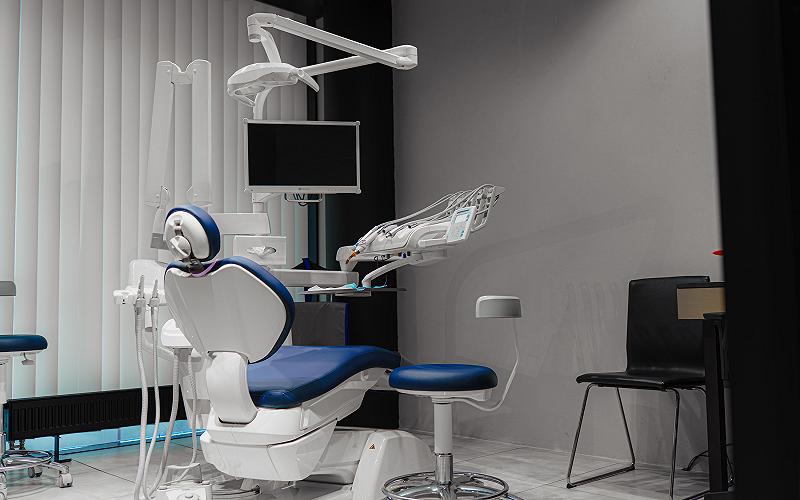
We care for your health with full commitment and professionalism.
Dental check-up and consultation
zł 150.00
Implantology consultation
zł 220.00
Prosthodontic consultation
zł 200.00
Oral surgery consultation
zł 200.00
Scaling, air polishing and fluoridation + OptraGate
zł 460.00
Periodontal check-up and consultation
zł 250.00
Pediatric dental hygiene (for children up to 14 years old)
zł 330.00
Tooth extraction
zł 400.00
Primary tooth extraction
zł 200.00
Dental treatment
from 400 zł
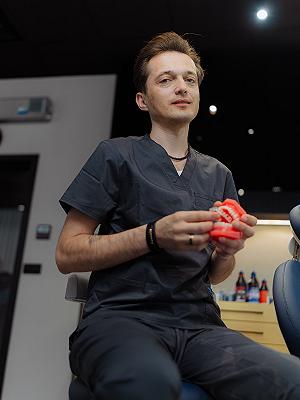
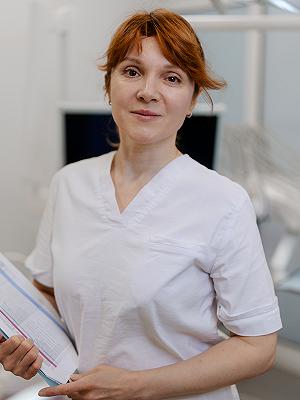
The success of our clinic is driven by experienced doctors – experts in their fields who combine knowledge, passion, and an individual approach to the patient.
What our clients say about us
Julianna Marchalewska

I highly recommend Dr. Volodymyr Livandovskyi - kind, professional, and committed. I am very satisfied with the visit!
Maksym Surzhok
Great dental clinic! Service at the highest level, doctors are very polite and professional. Treatments are painless, and the results are always pleasing. A comfortable atmosphere and modern equipment create pleasant conditions for treatment. I recommend it to everyone.
Nikita Pasechnyk
Kind staff, professional doctors, everything at the highest level. I recommend!
We have answers to all questions
Yes, we recommend prior registration – by phone or online.
No. We use modern and effective anesthesia, which makes the procedures completely painless and comfortable.
Yes, we have our own diagnostic equipment, including point X-rays and a pantomogram, which allows for quick and accurate diagnosis.
Of course. Regular check-ups and hygiene treatments are recommended every 6 months to maintain oral health and prevent cavities.
Yes, we offer consultations and dental treatment for children of all ages – in a friendly, stress-free atmosphere.
Yes, we perform root canal treatment using a microscope, which allows us to save teeth that would have previously required extraction.



.jpg)
.jpg)

.jpg)

.jpg)